
The following declaration is unlikely to make headlines, but the fact bears repeating: Smoking cigarettes causes cancer.
This wisdom has been well-absorbed. Cigarette smoking, especially youth smoking, remains at an all-time low in the United States. If there are any increases in youth smoking, they have yet to appear in the federal data. Message received, right?
Yes—mostly. We’re reupping the perhaps-obvious fact that cigarette smoking is wildly unhealthy and carcinogenic not just because good advice is timeless (though it is). An ethereal wind of tacit pro-cigarette sentiment has been blowing through the culture lately, aided by the powerful influence of depiction—which has been rising in media, including in top-grossing films (even those rated for young people).
The U.S. Surgeon General does not mince words on the subject. The Surgeon General’s official stance is that the relationship between smoking’s depiction and smoking’s practice is not just correlative; rather, cigarette smoking in top-grossing films directly and actively causes more young people to take up smoking.
As more media consumption takes place on streaming services—platforms where the depictions of tobacco use can occur more than twice as often than on traditional broadcast television—more young people may be induced to start smoking cigarettes or use other tobacco products. And it doesn’t take a scientific analysis to note that popular streaming-service offerings frequently include period pieces—shows in which cigarette smoke sometimes seems to outcompete every other element in the Earth’s atmosphere.
Perhaps as a function of this concerning trend, a slew of recent stories in major outlets have investigated or outright declared smoking as the emergent vice of choice for Generation Z, from the Financial Times to Scientific American to The New York Post.
As young people across the United States return to classrooms and college campuses—forums where the temptation to light up may arise among those who wish to burnish their countercultural bona fides—a review of smoking’s dangers feels warranted amid anecdotal upticks in cigarettes’ visibility among celebrities and smoking’s supposedly revived chic factor among the young.
Cancerous But Cool? Perceptions of Cigarettes’ Aesthetics
Despite cigarette smoke’s well-documented dangers, many people still see an appeal to smoking. If nobody did, it would be difficult to account for the nearly 18.7 million U.S. residents who smoke on a daily basis. Even if they have come to resent the habit (and many do, often saying they wish they’d never begun), smokers have to start somewhere.

One of those appeals, perpetuated in the coverage of Generation Z’s alleged interest in smoking, is the persistent belief among some that cigarettes lend their users an aura worth emulating. This puzzling phenomenon—the idea that a habit so deleterious to one’s health as smoking could be considered cool—is potentially explained by findings that purely aesthetic renderings of smoking can lead directly to cigarette use and addiction.
The relationship between cigarettes in movies and smoking behavior goes back decades. A study published in Cancer Epidemiology, Biomarkers & Prevention in 2009 found that the likelihood of adolescents ever experimenting with cigarettes increased as they were exposed to more smoking depictions in movies—an effect that was especially pronounced in Mexico-born youth, who had 58% higher odds of initiating smoking if they were exposed to smoking imagery via cinema.
Alas, for the film enthusiasts who might enjoy taking in the grey-blue curlicues of the smoldering cigarettes of “In the Mood for Love” or Clint Eastwood’s trademark cigarillo in “The Good, The Bad, and The Ugly,” such imagery comes with temptation to be resisted.
A Carcinogenic Catch-up: How Smoking Causes Cancer
By way of review, smoking causes cancer by introducing carcinogenic compounds directly into the mouth, airway, and lungs. The National Cancer Institute (NCI) reports more than 250 noxious chemicals in cigarettes, of which at least 69 are known to be carcinogenic—including arsenic, benzenes, polycyclic aromatic hydrocarbons (PAHs), and even the radioactive element polonium-210.
At the cellular level, these compounds wreak biological havoc by damaging DNA, which, in turn, triggers a cascade of mutations, inflammation, and oncogenic signaling. As early as the 1950s, scientists observed the toxic effects of cigarette smoke on cellular biology. A 1953 study published in Cancer Research showed that 44% of mice exposed to cigarette-tar condensate developed proven carcinomas—compared with 0% in the control group. In 1964, the U.S. Surgeon General released the landmark report establishing the causal link between cigarettes and cancer.
These biological insults, though they do indeed heavily impact the lungs, don’t just cause lung cancer. The 2025 edition of the Cancer Progress Report from the American Association for Cancer Research (AACR) lists a plethora of cancers caused by smoking tobacco, which collectively account for nearly the entire human body.
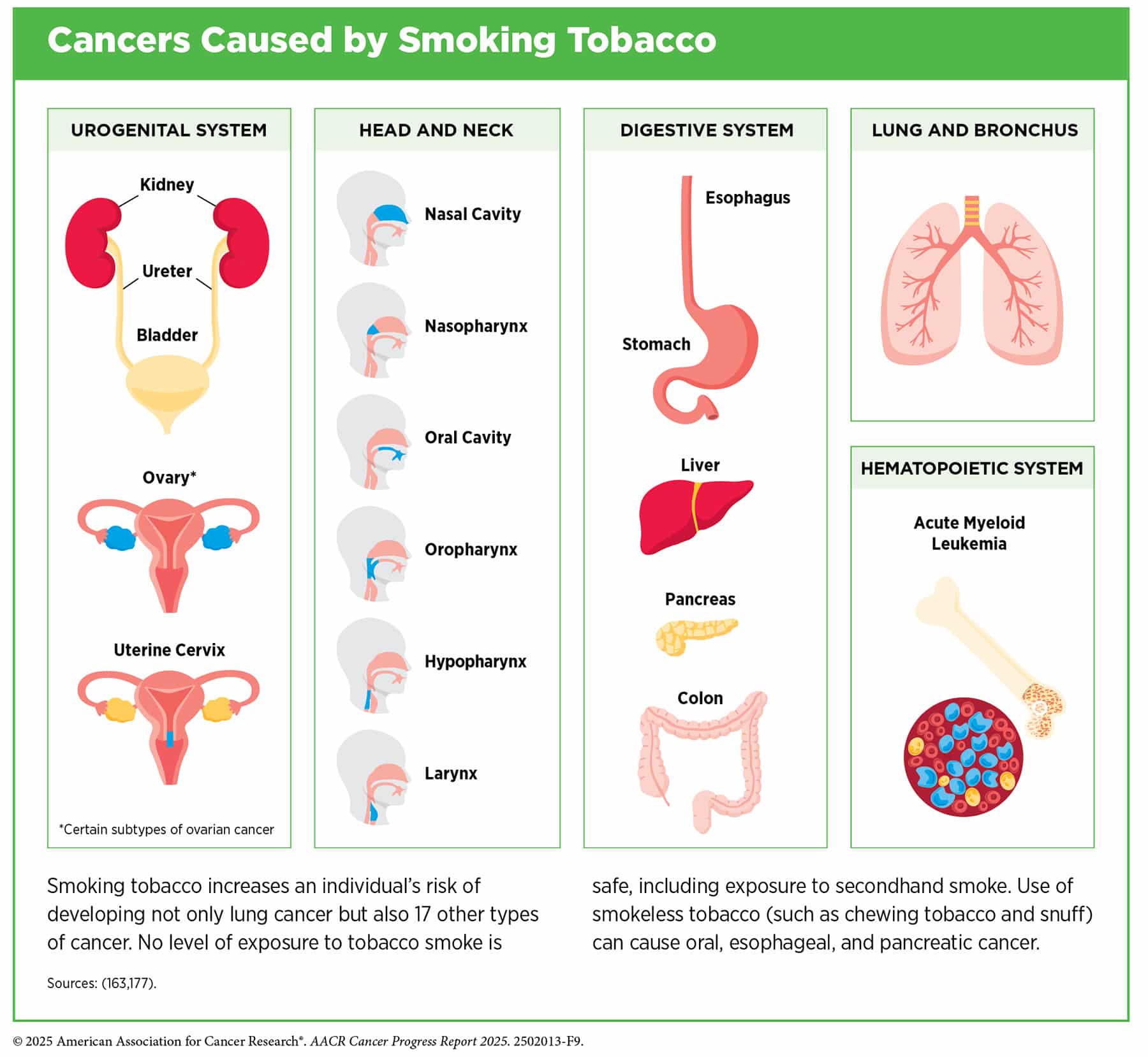
No amount of tobacco is healthy. Smoking even a single cigarette exposes users to more than 7,000 chemicals, and the nicotine addiction that cigarettes engender in smokers can drive decades of sustained use.
Because quitting smoking is so notoriously difficult—the majority of U.S. smokers say they want to quit, but fewer than 10% are able to do so—combatting cigarettes’ addictive capacity is a key concern for public health. A paper published in Clinical Cancer Research by members of the AACR Tobacco Products and Cancer Subcommittee outlined the benefits offered by a federal proposal to limit nicotine in combustible tobacco products, which the authors stated would likely prevent millions of deaths if enacted.
Smoking Status: A Sustained Downward Trend
The unequivocal good news is that smoking prevalence in the United States has never been lower. After peaking in 1965 at 42.4%, the U.S. smoking rate has fallen to only about 9.9% of all U.S. adults, according to the Centers for Disease Control and Prevention (CDC). Lung cancer incidence has also followed a downward trend (albeit a more recent one), peaking in the United States in 1992 at 66.4 cases per 100,000 but falling to 43.4 per 100,000 as of 2023, according to the NCI.
These declines have been especially pronounced among the young adult population of the United States. For individuals aged 15 to 39, lung cancer incidence more than halved from 1975, when 2.2 lung cancer cases occurred per 100,000, to just 0.7 cases per 100,000 in 2021.
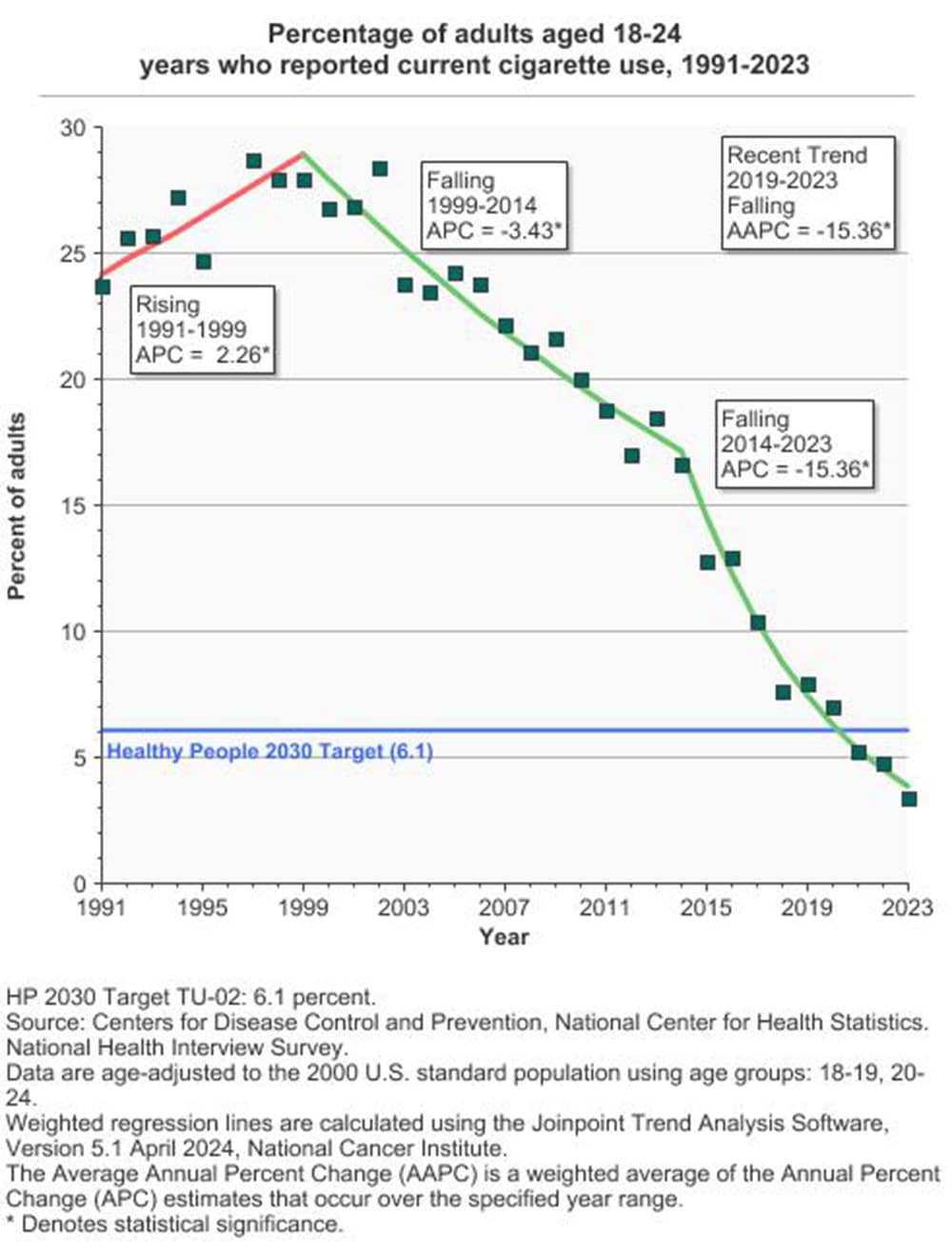
And despite coverage of a supposed resurgence in smoking’s vogueishness among the young, the current data do not indicate any increases among U.S. young adults. The NCI’s Cancer Trends Progress Report shows that smoking in adults aged 18 to 24 has continued a steep decline, falling by an average of 15.36% every year from 2014 to 2023.
So far, the only blinking warning light in the smoking data is the slowdown of smoking declines in several countries; these are not, however, outright trend reversals. Lung cancer incidence has somewhat rebounded recently among the young, jumping from the all-time low of 0.7 cases per 100,000 in 2021 for those aged 15 to 39 to 1.1 cases per 100,000 in 2023 (a 57% increase in just two years). But the factors that could potentially explain this uptick are myriad and overlapping, and rates of early-onset cancers are increasing in general.
Certain populations do continue to smoke at rates higher than the all-U.S.-adult baseline. As of 2022, when 11.6% of all U.S. adults reported smoking daily, smoking rates were higher in those aged 45 to 64 (14.9%); lesbian, gay, and bisexual adults (15.3%); adults with low annual household income (18.3%); and those with a GED as their highest educational attainment (30.1%—the highest reported smoking rate of any group within the dataset). These disparities are due in no small part to societal factors, including documented, long-standing targeted advertising efforts by tobacco companies.
Kinda Quitting: The Vaping Transition
E-cigarettes and nicotine-vapor devices (vapes) are being used by some as quitting aids that rank lower than cigarettes on what researchers describe as nicotine’s “continuum of risk.” However, none of these products has been approved by the U.S. Food and Drug Administration (FDA) as a way to stop smoking or quit other tobacco products. Proven tobacco cessation strategies exist, supported by the resources of federal, state, and local governments—and these recommended cessation strategies do not include vaping.
Additionally, vaping has become a vice unto its own, increasing sharply among U.S. adults—of whom 7% vape—and especially among youth. Though mitigation efforts have attenuated its prevalence among adolescents, U.S. high school students still continue to vape at a rate of 7.8% as of 2024.
One study found that, among students from 8th to 12th grade who vape daily, the rate of unsuccessful quit attempts has risen from 28% to 53%. And vape use is by no means a middle- and high-school phenomenon; a concerning 15.5% of young adults aged 21 to 24 engage in the practice as of 2023. Problematically, people who take up vaping in an attempt to quit smoking may end up as dual users of both tobacco products, an outcome associated with comparably negative outcomes as smoking alone.
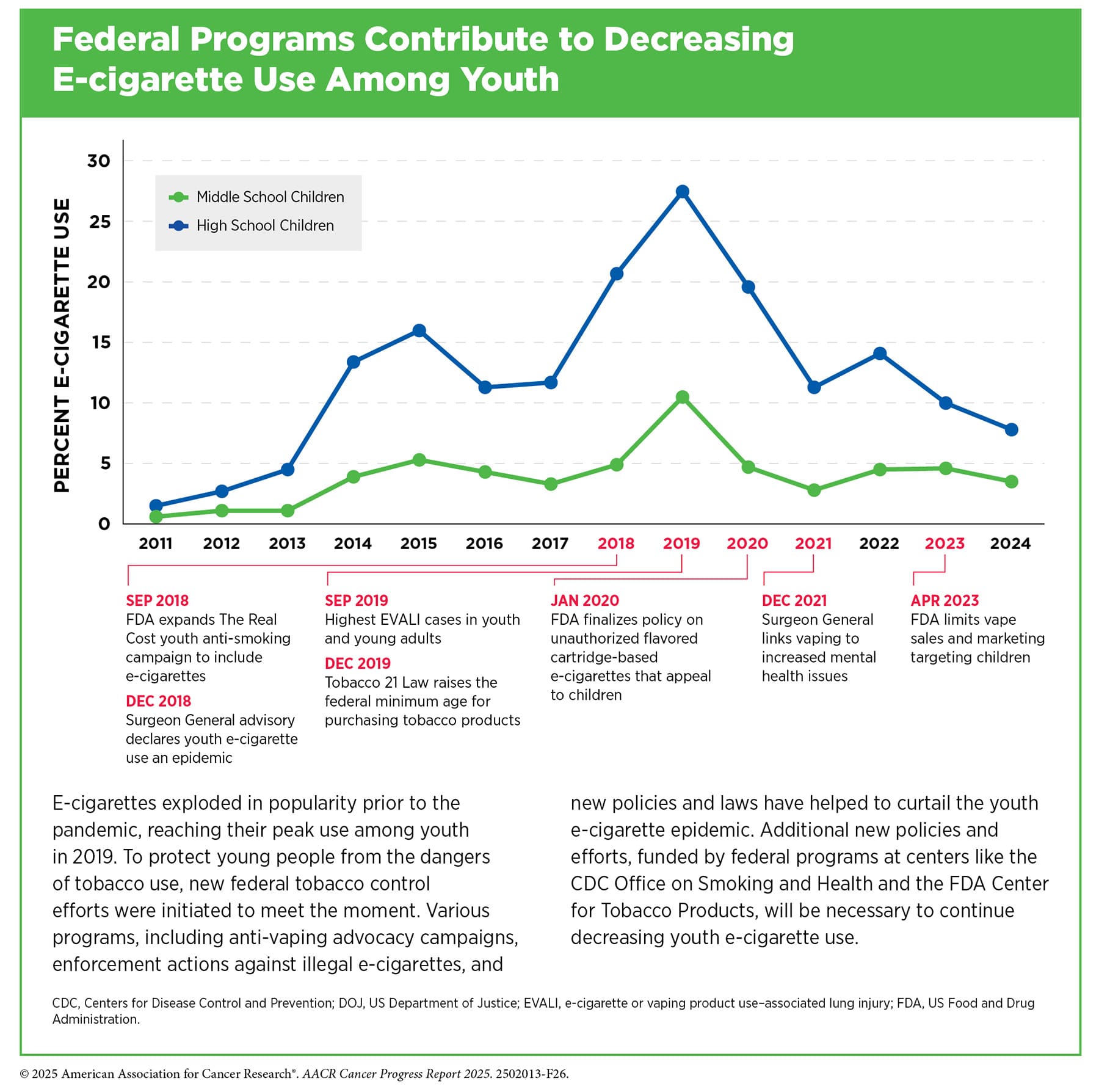
It is currently unclear whether vaping causes cancer; carcinogenesis typically takes years, and the rise of e-cigarette use is too recent for the data to be clear. However, vaping is clearly harmful. As the CDC says, “No tobacco products, including e-cigarettes, are safe, especially for children, teens, and young adults.”
Like their tobacco leaf antecedents, vapes also induce cell-level biological changes and contain a significant number of carcinogens—which suggests that, once data are mature, clearer links between vaping and cancer may emerge. One study published in Cancer Research showed that cell samples taken from both smokers and vape users with limited smoking histories shared changes consistent with lung cancer development; similar results have been replicated in other studies.
Vapes’ popularity among young people is likely due to the appeal of the flavoring agents that can make the addictive nicotine vapor taste like just about anything—from menthol to candy bars. One study found that the overwhelming majority of young vape users (89.4%) used flavored products, among which the most popular were designed to taste like fruit or desserts.
Most of these flavored products are illegal, despite the FDA’s 2026 authorization of a limited number of flavored vapes. But incomplete enforcement has allowed these youth-targeting products to remain on shelves. And it’s not just the flavors’ appeal that poses a threat—the chemical compositions of the flavoring agents may carry intrinsic risks of their own. One chemical analysis found that flavored nicotine vapor, compared with unflavored vapor, contained significantly more acetaldehyde (a possible carcinogen), acrolein (a probable carcinogen), and formaldehyde (a known carcinogen).
Other new tobacco products like nicotine pouches are also rapidly increasing in usage, and while less overtly dangerous than cigarettes, they present new potential for people of all ages, but particularly youth, to become or stay addicted to tobacco products—and experience negative health outcomes as a result.
The Best Time to (Not) Start Is Now
Long gone are the days of Joe Camel and his cigarette-promoting ilk thanks to federal restrictions on cigarette marketing, and for whatever the buzz about a cigarette comeback in the zeitgeist, smoking remains at historic lows. However, the use of new tobacco products is becoming increasingly prevalent; the trend, much like the unwelcome smolder of a lit cigarette, can and should be extinguished.
For those who don’t smoke, the habit is not worth picking up. Similarly, the use of e-cigarettes or nicotine pouches is also harmful and addictive. Anyone who does not use a tobacco product should not start—regardless of how suave media depictions may make it seem. For those who do smoke: It is no exaggeration to say that quitting may be lifesaving. The resources for those who wish to quit are ample; learn more about tobacco cessation at smokefree.gov.
The post A Reminder: Smoking Still Causes Cancer appeared first on American Association for Cancer Research (AACR).